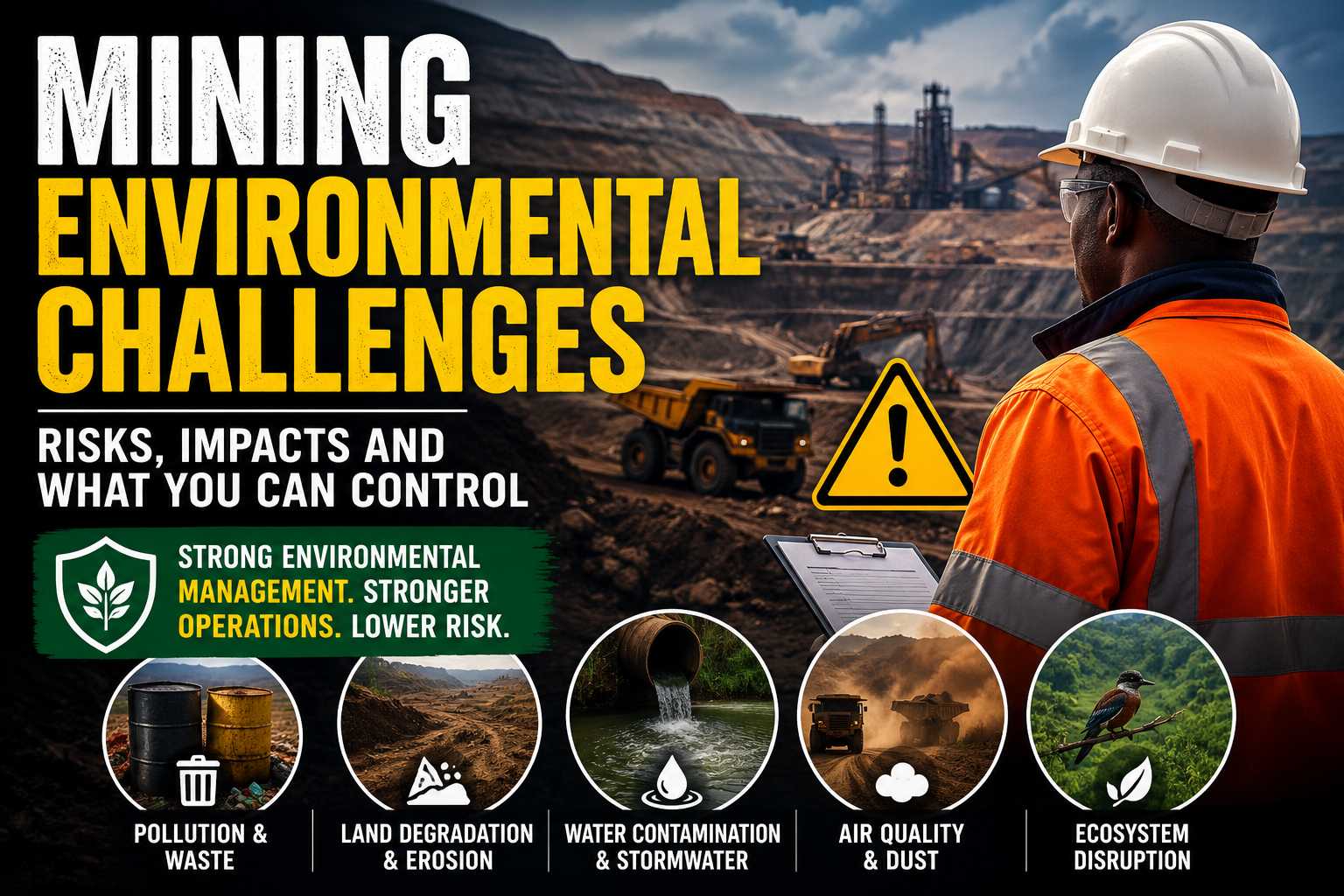
Mining keeps heavy industry in South Africa running, but it also pushes your environmental risk profile right to the edge. If you are responsible for procurement, facilities or SHEQ on a mining or industrial site, you live with that tension every day. You need reliable production, but you also have to protect air, water, land and ecosystems well enough to pass audits, keep the regulator off your back, and avoid shutdowns.
This is where environmental problems move from “background noise” to a very real operational and commercial issue. Pollution, land degradation, contaminated water, poor air quality and damaged ecosystems all sit on your risk register, whether you put them there or not. If your contractors cut corners, those problems land on your desk in the form of non conformance reports, findings in audit close out meetings, and emergency meetings with management.
Environmental management around mining is not just an environmental department problem. It is a procurement and facilities management problem too.
The real environmental footprint of mining operations
On paper, most sites have environmental policies, procedures and a stack of plans. On the ground, the pressure to keep production up can easily create blind spots. To manage your vendor panel properly, you need a clear view of the main environmental challenges that show up again and again around mining and related industrial operations in South Africa.
1. Pollution and contaminated waste streams
Pollution on mining and heavy industrial sites rarely comes from a single source. It is usually a mix of:
- Process waste from production areas
- Hydrocarbon spills from workshops and vehicle yards
- Hazardous waste from maintenance and specialised cleaning
- General refuse, recyclables and organic waste around offices and accommodation areas
If these streams are not separated, labelled, stored and removed correctly, you do not just have “dirty areas”. You have a compliance problem sitting in a skip or a waste bay. One wrong contractor, one missed manifest or one unsecured waste stockpile can trigger findings during inspections and environmental audits.
From a procurement point of view, this is where the gap usually appears. Cleaning, waste handling, industrial services and rehabilitation often sit with different service providers under different SLAs. No one looks at the full chain of custody for contaminated materials, and it becomes very hard to prove compliance when an auditor asks, “Show me how this waste left the site, and where it went.”
2. Land degradation and unstable surfaces
Mining changes land, often permanently. You deal with disturbed soil, stockpiles, haul roads, laydown areas and open ground around plant and infrastructure. Without proper rehabilitation and ongoing maintenance, you start to see:
- Severe erosion around roads, pipelines and drainage channels
- Unstable slopes that threaten infrastructure and access roads
- Dusty open areas that spread sediments and contaminants
- Abandoned or poorly closed temporary work areas
To you, this is not just an environmental issue. It is an asset and safety issue. Poor land management affects stormwater flows, undermines roads, and increases the load on your drainage and pollution control systems. It often sits awkwardly between contractors that “only clean”, “only landscape” or “only do civils”. If none of them are contracted or competent to handle environmental rehabilitation properly, the land keeps degrading and you keep inheriting the risk.
3. Water contamination and stormwater problems
Water is usually the quickest way an environmental problem becomes a headline or an enforcement action. Around mining operations, contamination can come from:
- Process water and slimes
- Runoff from dirty areas and stockpiles
- Hydrocarbon leaks in workshops and fuel storage zones
- Incorrectly managed wash bays, drains and sumps
If clean and dirty water systems are not separated, and if pollution control dams, trenches and silt traps are not maintained properly, you face three headaches at once. Non compliance against your water use and environmental authorisations, operational disruptions when flooding or blockage occurs, and reputational exposure if water leaves your boundary in poor condition.
From a facilities and procurement angle, the weak point is usually maintenance of drains, sumps, oil separators, bunded areas and stormwater channels. These areas often sit in a grey zone between “cleaning” and “engineering”. Contractors that only see themselves as janitorial service providers usually do not understand the environmental consequences of a blocked drain or overflowing sump.
4. Air quality and nuisance dust
Air quality problems are not limited to stack emissions. On mining and heavy industrial sites, most day to day complaints and findings come from:
- Uncontrolled dust from roads, stockpiles and open ground
- Fine particulates from processing and materials handling
- Odours from waste areas, sumps and poorly cleaned facilities
When contractors do not follow proper housekeeping, material containment and dust suppression practices, your air quality risks escalate. Even if emissions from core plant are compliant, you can still face community complaints or internal incidents because of surface dust, uncleaned spills or neglected waste areas.
This is where seemingly “simple” activities, for example sweeping, washing, vegetation maintenance and waste removal, have a direct impact on environmental performance. If you buy those services on price only, and you use multiple vendors that do not coordinate, you pay for it later with complaints and extra clean up work.
5. Ecosystem disruption around and beyond the fence line
Mining opens up land, removes vegetation and changes drainage patterns. Over time, this affects surrounding ecosystems and biodiversity. In practical terms, you see:
- Loss of natural vegetation and uncontrolled encroachment by invasive plants
- Disturbed habitat in riparian zones and around wetlands
- Changes in surface and groundwater that affect surrounding land users
For you, the direct risk shows up in environmental audits, rehabilitation liabilities and conditions attached to permits and licences. Regulators expect to see active rehabilitation, invasive species control and protection of sensitive areas. If your service providers only “cut grass” or “clean” without understanding these requirements, they can make problems worse, for example by disturbing protected areas or dumping material in the wrong place.
Why this matters to South African industrial and mining operations
All of these environmental problems tie straight back to how you contract, brief and manage your service providers. Each pollution risk or degraded area on site has a line in someone’s SLA. If you spread cleaning, waste, pest control, landscaping and rehabilitation across too many vendors, you increase the chances that something falls between the cracks.
In the South African context, this sits on top of your transformation, BEE and local content commitments. When you shortlist vendors, you cannot only ask, “Can they supply people and equipment, and what is their rate.” You need to ask, “Can they work safely in a high risk environment, support our environmental obligations and still give us the Level 1 BEE and compliance profile we need.”
The environmental problems linked to mining are not abstract. They are directly connected to the quality, scope and integration of the services you procure.
If you want a deeper look at what an integrated approach can look like in practice, you can review a broader view of facilities, environmental and compliance services tailored to heavy industry. This kind of integration is what starts to close the gap between “environmental risk on paper” and “controlled environmental performance on site”.
How mining environmental problems hit your operations where it hurts
Environmental risk from mining does not stay in the environmental file. It shows up on your procurement dashboard, in your facilities budget, and in the quality of sleep you get before an audit or site inspection.
If you sit in procurement, facilities or SHEQ, you feel the pressure from three sides at once. Production wants availability, the regulator wants compliance, and the community wants assurance that you are not damaging their air, land and water. The gap between what is on paper and what actually happens on site is where your real exposure sits.
1. Compliance failures that start with “small” contractor gaps
Most non conformances do not start with a major incident. They start with small misses in everyday service delivery. A contractor skips proper waste segregation, a cleaning team dumps dirty water into a stormwater drain, a landscaping crew disturbs a sensitive area because it was not properly marked.
From a procurement and facilities angle, this looks like:
- Unclear scopes that do not tie daily tasks to specific permit or licence conditions
- Contractors who are competent in basic cleaning or grounds work, but not trained for high risk mining environments
- No single vendor responsible for checking that environmental controls are kept intact during routine work
The result is predictable. You walk into an audit, the regulator or corporate auditor walks your site, and the findings point straight at contractors. Waste bays not compliant with your authorisations, contamination visible outside bunds, incomplete manifests, uncontrolled vegetation or erosion. On the report, it is not “the contractor’s problem”. It is your organisation’s non conformance, signed off next to your name.
Every environmental condition in your permits needs a clear operational owner, and your contractors are often the missing link.
2. Reputational damage that procurement cannot fix with a new vendor
When environmental problems reach neighbours, social media or media outlets, the story is simple. A mine or industrial site has polluted, damaged land or caused a nuisance. No one outside cares which subcontractor was responsible, they only see your brand.
That public perception feeds back directly into your work in procurement and facilities management. You see it as:
- Higher scrutiny during permit renewals and applications
- More conditions attached to licences that you must build into contracts
- Internal pressure to “tighten up” controls without extra budget or resources
Once your site is seen as a problem operator, every audit is harder and every incident is judged against that history. This makes vendor selection far more sensitive. You can no longer get away with ticking a few generic safety boxes and picking the cheapest quote. You need suppliers that help you rebuild trust by consistently delivering compliant, visible environmental housekeeping.
3. Operational disruptions triggered by environmental issues
Environmental problems do not just live in reports. They disrupt operations in very practical ways. Poor stormwater and waste management floods access roads, clogs sumps and creates slip hazards. Dust and poor housekeeping interfere with equipment, visibility and health. Unstable ground and erosion damage roads, pipelines and laydown areas.
From your side, that means:
- Unplanned shutdowns for clean up, spill response or emergency repairs
- Restricted access to certain areas while rehabilitation or remediation takes place
- Reactive work orders that were never budgeted for, often at premium rates
The frustrating part is that many of these disruptions are avoidable with the right routine services. Regular maintenance of drains, sumps and pollution control structures, disciplined waste handling, and proper housekeeping in high risk areas all reduce unplanned downtime. When those tasks are split across several low cost vendors, no one sees the whole picture, and you end up paying for avoidable outages later.
4. Direct financial penalties and hidden cost creep
Formal penalties are the obvious risk. If you breach conditions of an environmental or water authorisation, you can face enforcement actions, directives and, in serious cases, prosecution. Those outcomes carry financial consequences that do not sit neatly in any one cost centre.
But the hidden financial impact often hurts more in the long term. You see it as:
- Frequent unplanned clean up and rehabilitation jobs that were not scoped into contracts
- Expedited compliance work before audits because routine tasks were not done correctly
- Admin load across procurement, SHEQ and operations to chase missing documentation, permits and manifests
On paper, you might have secured a “good rate” for cleaning, landscaping or waste removal. In practice, you carry extra internal costs in overtime, rework, investigations and follow up meetings. When you add those soft costs to the invoice amount, the cheap contractor looks a lot more expensive.
Environmental non performance always gets paid for by someone. If it is not in the vendor price, it lands in your overheads and risk budget.
5. Increased complexity in audits and RFQ processes
Every environmental problem that lands in an audit finding turns into a new requirement in your next RFQ. Over time, you accumulate a long list of conditions, checklists and mandatory documents that you are expected to build into your vendor selection process.
That complexity shows up as:
- RFQs packed with detailed environmental and safety requirements that many generic contractors cannot meet
- Longer evaluation cycles because you must verify certificates, registrations and method statements
- Confusion about which vendor owns which environmental obligation, especially when scopes overlap
When cleaning, waste, pest control, landscaping and rehabilitation all sit with different suppliers, you are forced to manage multiple sets of documentation, OHS and environmental files and contractor packs. Each vendor has its own risk profile and its own gaps. This increases the chance that, during an audit or incident investigation, someone discovers missing or outdated documents in your files.
6. How this shapes vendor strategy for South African mining and industry
In the South African context, environmental impact and procurement strategy are also linked to transformation and reporting requirements. You do not only need a supplier who can perform the work. You need a partner that ticks environmental, safety and BEE boxes without creating more admin for you.
For high risk mining and industrial environments, that means actively looking for:
- Vendors that understand environmental conditions in permits and licences, not just generic “green” language in a proposal
- Level 1 BEE suppliers who can consolidate multiple services under one SLA, so liability and documentation sit in one place
- Teams trained for high risk sites who know how daily cleaning, waste handling and grounds work impact compliance
If you keep treating environmental services as low value, price driven contracts, you keep importing risk into your operation. If you shift to integrated, compliance aligned services, you reduce the number of variables you have to manage every month.
That is exactly why many sites move toward integrated facilities and environmental services rather than a long list of narrow contractors. When one competent, Level 1 BEE vendor owns the day to day environmental housekeeping, you gain clearer accountability, cleaner audit trails and fewer surprises when inspectors arrive.
Compliance and regulatory frameworks that shape your vendor choices
If you work on a South African mining or heavy industrial site, you do not need a lecture on “environmental responsibility”. You need clarity on what the law expects from you, what must sit in your contracts, and what you should demand from every environmental services vendor that steps onto your site.
This is where environmental management, procurement, SHEQ and transformation all meet. The regulator does not care whether a contractor caused the problem. They hold the operation accountable. That means your vendor panel must be aligned with South African environmental law, permit conditions, BEE requirements and recognised management standards such as ISO.If a vendor cannot support your compliance profile, they do not belong on your shortlist.
1. Core environmental laws you are buying compliance against
You do not need to recite legislation, but you do need to understand how it flows into vendor scopes and documentation. In practice, your environmental service providers should be working in line with three main areas of law on every site:
- General environmental protection, which underpins how you manage pollution, land, ecosystems and rehabilitation obligations
- Water and waste management, which drives how you handle contaminated runoff, dirty water systems, waste separation, storage and disposal
- Air quality and nuisance control, which affects how contractors manage dust, odours and emissions from their activities
For procurement and SHEQ, the key question is simple. Can this vendor work in a way that supports our authorisations, licences and permits, not fight against them.
To get that right, build the link between legislation and scope. For example, if your site has strict water use and discharge conditions, your cleaning and waste vendors must have clear responsibilities for:
- Segregating clean and dirty water
- Protecting stormwater systems from contamination
- Managing wash bays, sumps and oil separators in line with permit requirements
If they cannot explain how their methods align with your permits, they raise your risk profile from day one.
2. Permit and licence conditions that drive contractor behaviour
On most mining and industrial sites, the real compliance pressure comes from conditions attached to approvals and licences. Those conditions often cover:
- Waste management and reporting
- Stormwater and dirty water controls
- Rehabilitation targets and land use after closure
- Protection of sensitive areas, including wetlands and riparian zones
- Air quality controls, especially dust and nuisance emissions
Every one of those areas is touched by cleaning, waste, grounds, pest control and rehabilitation vendors. The problem is that, in many contracts, this link is never made explicit. You end up with generic scopes that say “keep area clean” without tying that to any specific permit condition.
A practical way to close this gap is to create a simple framework that your team can use when drafting scopes and RFQs:
- List key permit and licence conditions that are affected by day to day environmental services. Use short, plain language summaries.
- Match each condition to tasks that vendors will perform. For example, a condition on preventing contaminated runoff links directly to drain cleaning, bund checks and waste storage.
- Write those tasks into the scope as explicit requirements, not as vague housekeeping expectations.
- Ask vendors to describe their method for meeting those specific conditions in their proposals and method statements.
If a vendor cannot or will not work at that level of clarity, they are not aligned with the compliance reality of a mining or heavy industrial site.
3. BEE compliance, Level 1 vendors and what it means in practice
In South Africa, BEE is not a separate checkbox from environmental performance. You are expected to achieve commercial, environmental and transformation outcomes at the same time. For you as a procurement or facilities manager, that usually comes down to three priorities:
- Use Level 1 BEE suppliers where possible to support your scorecard and reporting
- Consolidate services under fewer compliant vendors so that your BEE spend, environmental risk and documentation sit in one place
- Reduce admin load by avoiding multiple low level suppliers with weak paperwork and inconsistent performance
When you assess BEE compliance for environmental services vendors, do not stop at the certificate. You should build at least the following into your RFQ and onboarding process:
- Valid BEE certificate aligned to your organisation’s minimum level requirements
- Clear indication of ownership structure that matches the certificate
- Commitment to maintain or improve BEE status over the life of the contract
The big benefit of using a strong Level 1 BEE vendor that can cover cleaning, waste, pest and landscaping is that you can channel a larger slice of your spend into one compliant supplier instead of spreading it thinly across several marginal providers. One integrated partner, for example a specialist like Amalt Integrated Services, also simplifies your environmental and safety oversight, because there is a single point of accountability for day to day site hygiene.
4. ISO aligned management systems and why they matter for you
Many tenders and RFQs now request ISO aligned management systems for quality, environment and safety. That is not just a certification vanity metric. On a complex site, an ISO aligned vendor is more likely to:
- Work with documented procedures that you can review and align with your own
- Maintain records and logs that support your audit trail
- Investigate incidents properly and implement corrective actions
When you evaluate vendors, ask for structured proof of their management systems. For example, you can request:
- High level descriptions of their environmental and safety management processes
- Templates of checklists, inspection records and incident reports that they use
- Evidence that they perform internal audits and management reviews
You are not just ticking a box that says “ISO aligned”. You are checking whether their internal discipline will strengthen your own compliance posture or create more firefighting for your SHEQ team.
5. Critical vendor documentation you should insist on
If an environmental services vendor cannot produce solid documentation, they are adding risk to your site. At a minimum, you should build a consistent documentation pack that every vendor must submit and keep updated.
A practical template looks like this:
- Company and legal compliance
- Company registration details and tax clearance
- BEE certificate and supporting ownership information
- Proof of required registrations related to environmental work, where applicable
- Safety and environmental records
- Summary of incidents and near misses for a defined period, for example the past [insert period]
- Details of any enforcement actions or prohibitions they have received
- Evidence of corrective actions and lessons learned processes
- Technical credentials
- Registered Pest Control Operator certificates for pest work
- Proof of training for staff working in high risk areas, including hazardous waste and confined spaces where relevant
- Evidence of environmental rehabilitation capability for vendors offering land restoration services
- Site specific documentation
- Method statements aligned to your site conditions and permits
- Risk assessments and job specific safety plans
- Waste handling and disposal procedures, including manifest management
Build this pack into your RFQ, not as a last minute scramble before mobilisation. If a vendor cannot submit it fully and accurately during evaluation, they are unlikely to maintain solid OHS and environmental files once they start work.
6. What procurement and SHEQ should check together
Environmental compliance is not something you can outsource completely to SHEQ. Procurement controls who gets through the gate. SHEQ controls the technical standards. To avoid gaps, agree on a simple joint checklist that every environmental services vendor must pass before appointment.
That checklist should at least cover:
- Regulatory alignment Clear confirmation that the vendor understands which permits and conditions affect their work on your site.
- BEE and transformation fit Verified BEE status that supports your targets, with preference for Level 1 suppliers that can bundle multiple services.
- ISO aligned systems Proof of structured safety, quality and environmental processes, not only marketing claims.
- Complete documentation pack All core documents received, checked and filed into your OHS and environmental management systems before mobilisation.
- Competence for high risk environments Training records, registrations and rehabilitation capability where required for mining and heavy industrial sites.
Once you apply this consistently, poor fit vendors fall out early, and you end up working with partners that reduce your environmental risk instead of adding to it. If you want support in designing this kind of integrated, compliance focused vendor model, you can review how a provider like specialised compliance and environmental services are structured for South African heavy industry.
The hidden chaos of managing separate environmental service contractors
If you are juggling separate contracts for cleaning, waste, pest control and landscaping on a mining or industrial site, you already know the story. On paper, each contractor “owns” their scope. In reality, environmental issues rarely respect those boundaries, and you are the one stuck stitching everything together before the next audit or site inspection.
This is where environmental risk, admin overload and accountability gaps all meet. The more fragmented your vendor panel, the more exposed you are.
1. Accountability gaps that no SLA can fix on its own
Environmental problems almost never come from one isolated task. They come from the gaps between tasks and suppliers.
Typical pressure points look like this:
- Shared areas with no clear owner Waste bays, laydown areas, bunded zones and wash bays sit in a grey area. Cleaning says it is waste’s responsibility. Waste says it is “site housekeeping”. Landscaping says it only handles vegetation. When an auditor asks who is responsible, everyone points sideways.
- Environmental controls that get damaged during routine work Contractors move bins, remove bund cushions, cut drainage channels through berms or pile soil against fences. None of them see that they have just damaged a pollution control measure that supports your permits.
- Spills and incidents that fall between scopes A small spill in a workshop might involve cleaning, waste handling and grounds teams. If no single vendor owns the full clean up process, the job is half done, and the residue appears in your next inspection.
Each contractor will tell you they complied with their SLA. The regulator will tell you the site failed. That gap lands squarely on procurement and facilities, because your team signed the contracts and is expected to enforce performance.
If accountability is split, responsibility still sits with you.
2. Compliance risk multiplied by every extra contractor
Every contractor you add to your site brings a new set of risks into your environmental and OHS files. It is not just about whether they clean, cut or collect properly. It is about whether they can operate inside your legal framework.
With multiple small or generic contractors, you face:
- Inconsistent understanding of permits One vendor understands stormwater controls, another has never seen your water use or waste authorisation. They work next to each other, but to completely different standards.
- Documentation gaps everywhere Each supplier has its own risk assessments, method statements, manifests and training records. Some are updated, others are not. During an audit, you scramble to find the right file for the right contractor and discover that half the documents are expired or missing.
- Weak environmental competence Low cost vendors who focus only on “cleaning” or “gardening” usually do not have registered Pest Control Operators, rehabilitation capability or properly trained teams for high risk mining environments.
The regulator does not accept “the contractor did not know” as an explanation. They expect your contractors to work at the same standard as your internal teams. If you keep appointing suppliers who treat mining and heavy industry like a generic office park, you keep importing compliance risk into your operation.
3. Admin overload that drags procurement and SHEQ into firefighting
Managing 4 to 6 separate contractors does not just add a few extra emails. It changes how your entire month looks.
- Multiple RFQs and renewals Each service line runs on its own tender or RFQ cycle. You are repeatedly drafting scopes, answering the same questions, evaluating quotes and onboarding vendors for work that could sit under one structured SLA.
- Duplicated vendor vetting For every contractor, you collect BEE certificates, safety records, insurances, environmental method statements and tax compliance. The same checks, repeated several times, with no added benefit.
- Fragmented invoicing and cost tracking Finance receives separate invoices for cleaning, waste, pest and landscaping, sometimes with overlapping descriptions. You lose visibility on the true cost of “environmental housekeeping” across the site.
- Chasing documents before every audit Before an internal or external audit, procurement and SHEQ scramble to update permits, manifests, training records and incident logs from each contractor. The more vendors you have, the more time you burn just getting files into shape.
This admin load usually does not show up clearly in budgets, but it drains hours out of your skilled people. Your SHEQ staff spend more time scanning certificates and filing paperwork than improving systems. Your procurement team spends more time policing compliance than optimising value.
4. Operational coordination that never quite lines up
Cleaning, waste handling, pest control and landscaping all influence each other on site. When different companies manage them without integration, friction and blind spots are guaranteed.
- Misaligned schedules Waste is collected on one day, cleaning teams arrive the next, landscaping clears an area the following week. By the time each team finishes, the area has gone through three different states, and your site looks inconsistent.
- Conflicting methods Pest control uses treatments that affect flora, landscaping applies products that interfere with pest control, cleaning teams use chemicals that contaminate areas meant to be low risk. No one is coordinating methods with a single environmental plan in mind.
- Communication breakdowns When an issue appears, for example recurring odours from a waste area, you end up calling three different supervisors before anyone accepts responsibility. In the meantime, the problem continues.
On a high risk site, this lack of alignment does not just look untidy. It feeds directly into findings about housekeeping, contamination risk and poor control over contractors.
5. Losing the “big picture” of environmental performance
When you split environmental services across several suppliers, no single contractor is responsible for the overall condition of your site. Each one focuses on a slice, and no one is paid to see the whole.
The result is predictable:
- No consolidated reporting You receive separate reports, if at all, for cleaning, waste, pests and grounds. None of them link to your permits, KPIs or environmental management plan.
- Slow detection of emerging risks Erosion starts near a road, a drain blocks repeatedly, or waste areas gradually overflow. Contractors see it but do not flag it, because it is “not in their job card”. You only become aware when the problem is already big enough to show up in inspections.
- No partner in rehabilitation thinking Most generic contractors think in days or weeks, for example “this week’s cuts” or “this month’s cleaning program”. Rehabilitation and sustainable land management require a longer view that fragmented vendors usually do not bring.
On complex mining and industrial sites, you should expect at least one partner to think about erosion control, long term land stability and sustainable housekeeping. If everyone you contract is transaction focused, you are left to carry that strategic thinking alone.
If you want a sense of what integrated rehabilitation and land care can look like when it is treated as part of ongoing operations, not an afterthought, you can review how environmental rehabilitation services are structured for industrial sites.
6. Why fragmented vendors keep costing you more than the quote
On RFQs, it often looks cheaper to appoint a low cost specialist for each small service. The cleaning company with the lowest rate wins. The gardener with the simplest quote gets the grass cutting. The cheapest pest controller takes that line item.
In practice, that approach usually produces:
- Higher total cost of coordination Your internal team becomes the de facto “integrator”, unpaid, trying to align multiple suppliers that never speak to each other.
- More rework and corrective jobs One contractor’s short cuts create problems that another contractor has to fix. You end up issuing ad hoc orders and paying extra for jobs that would have been unnecessary if the original work was done correctly and in line with your environmental plan.
- Less leverage with each vendor With spend scattered across several suppliers, none of them treat you as a strategic client. They protect their narrow scope, and you lose the ability to demand higher standards or integrated solutions.
When you add the internal time cost, repeat clean ups, rush jobs before audits and risk exposure, the “cheapest” combination of small contractors often becomes the most expensive way to manage environmental services.
7. What procurement and facilities managers in South Africa really need instead
If you work on a mining, petrochemical or heavy industrial site in South Africa, your reality is simple. You need environmental services that support your permits, your BEE targets and your internal resource constraints at the same time.
Managing a patchwork of contractors fights against that goal. Procurement spends more time firefighting. SHEQ spends more time chasing files. Operations spends more time reacting to avoidable problems.
This is why many teams in your position start looking for a single, Level 1 BEE supplier that can bundle cleaning, waste, pest and landscaping into one integrated service, with one SLA and one set of environmental commitments. When you do that well, you stop arguing about whose job it was, and you start asking a better question.
Is our site getting cleaner, safer and more compliant every month, or not.
If your current mix of contractors cannot answer that question positively, the way you are structuring environmental services, not just the vendors themselves, is part of the problem.
Why bundled environmental services from a Level 1 BEE vendor change the game
By this point, you have probably felt the pain of fragmented contractors. Cleaning here, waste there, landscaping somewhere else, pest control when someone complains. Everyone has a piece of the site, but no one owns the environmental outcome.
Bundling those services under one competent, Level 1 BEE vendor with a single SLA is not a “nice to have”. It is one of the most direct ways to cut risk, clean up your admin and get your environmental house in order on a mining or heavy industrial site.One contract, one set of standards, one throat to choke. That is what you are aiming for.
1. Clear accountability instead of finger pointing
When you appoint separate contractors for cleaning, waste, pest control and landscaping, you create natural excuses for everyone involved. When something goes wrong, each contractor explains why it was someone else’s job. You are left refereeing.
With a bundled solution under one SLA, the picture changes completely.
- Single owner for site condition The integrated vendor is responsible for the overall environmental housekeeping in their scope areas. If the waste bay is a mess, drains are blocked or vegetation is unmanaged, you have one company to call, not four.
- Aligned teams, shared objectives Cleaning staff, waste collectors, pest technicians and grounds crews all work for the same provider, under the same supervision and KPIs. They stop arguing about whose job a task is and start solving problems together.
- Environmental performance in the SLA Instead of vague “keep area clean” statements, you can write in outcome based measures linked to your permits, for example “no contaminated runoff from designated areas” or “waste bays maintained according to site standards”. One vendor signs for those outcomes.
For you, that means fewer meetings to get to the bottom of simple issues and a much stronger position in performance reviews. If the site standard is not met, there is no confusion about who needs to fix it.
2. Reduced compliance risk across the whole contractor chain
Every extra environmental services contractor multiplies your risk. Different safety files, different training levels, different levels of understanding of your permits. When you consolidate with a Level 1 BEE supplier that actually understands mining and heavy industry, you start to close those gaps.
- One environmental method, applied consistently The bundled vendor designs procedures that line up with your site permits and environmental management plans, then trains all their teams on the same rules. The person sweeping a workshop floor and the person clearing a drain are working from the same environmental playbook.
- Simpler OHS and environmental files Instead of trying to maintain full documentation for several small contractors, you maintain one robust file for one integrated provider. Their internal systems carry more of the load, and your SHEQ team stops drowning in duplicated paperwork.
- Better competence for high risk work A serious bundled vendor is more likely to have registered Pest Control Operators, people trained for hazardous waste handling, and teams who understand high risk infrastructure areas. You are not trying to teach a “domestic” contractor how to work inside a mining environment.
You still have to manage and audit the vendor, but you are no longer trying to police multiple small operators who may never have seen a mining permit before they arrived on your site.
3. Lower admin costs and less internal firefighting
Procurement and SHEQ teams feel the admin load of fragmented contractors more than anyone else. When you move to a bundled solution, you immediately take pressure off both functions.
- One RFQ, one evaluation Instead of running separate RFQs for cleaning, waste, grounds and pest services, you can structure a single, comprehensive tender for integrated environmental services. You evaluate one set of documents and one pricing model.
- Streamlined onboarding and renewals BEE certificates, tax clearance, safety records, ISO alignment, method statements and insurances are collected once, from one supplier. Contract renewals and reviews are scheduled with a single partner.
- Consolidated invoicing and cost visibility Finance receives clearer, bundled invoices that reflect the true cost of environmental services. You can see exactly what you are paying to keep the site clean, safe and compliant, instead of chasing scattered line items across multiple cost centres.
- Fewer last minute document chases Before audits, your team works with one vendor contact to close documentation gaps, not five different companies with different levels of admin discipline.
The direct saving in hours is significant. More important, your skilled people can put their time back into improving systems and planning, instead of chasing signatures and expired certificates.
4. Stronger integration with BEE and transformation targets
For South African mining and heavy industry, BEE is not optional. It directly influences your ability to win and retain core business. When you spread environmental spend across multiple small suppliers with weak BEE profiles, you dilute your impact.
A bundled solution delivered by a Level 1 BEE vendor changes that dynamic.
- Concentrated spend with one Level 1 partner Cleaning, waste, pest control and landscaping all sit under a single Level 1 supplier. Your BEE reporting benefits from a higher quality spend profile, and you can demonstrate meaningful engagement with a strong partner rather than token spend with multiple marginal vendors.
- Aligned reporting and supplier development You can build transformation commitments directly into the SLA, for example local employment, training targets or subcontracting frameworks, and monitor them through one relationship.
- Less exposure to non compliant suppliers By reducing the number of vendors, you reduce the chances of a weak or expired BEE certificate slipping through and damaging your own scorecard or internal reporting.
From a governance perspective, it is far easier to defend one well structured, Level 1 partnership in an internal review than a long list of small suppliers with patchy credentials.
5. Better operational coordination on the ground
On site, environmental performance depends on how well daily tasks line up. Street sweeping, bin removal, grass cutting, slope stabilisation, pest treatment and drain cleaning all interact. If those tasks are split across several companies, you get gaps and clashes. Under one integrated provider, you get a single operational plan.
- One schedule, fewer clashes The bundled vendor can coordinate weekly and monthly programs so that, for example, waste removal aligns with cleaning routes, and vegetation control ties in with erosion control and pest management.
- Single site supervisor contact Your operations teams do not need to phone three or four supervisors to solve a simple issue. They escalate to one accountable supervisor or contract manager who then aligns their internal teams.
- Faster response to incidents When a spill, odour or pest problem appears, the integrated vendor can deploy the right combination of people at once, instead of waiting for separate contractors to coordinate availability.
That coordination shows up directly in audits and inspections. Areas look consistently controlled, not like a patchwork of different standards and schedules.
6. Stronger environmental oversight and reporting
Auditors, regulators and corporate reviewers want to see evidence that you understand your environmental risks and that you have them under control. A bundled service model can give you better data and visibility, provided you structure it correctly.
- Consolidated environmental reporting The integrated vendor can provide regular reports that cover waste volumes, incidents, observations, housekeeping checks, pest activity and grounds condition in one document. You get a clearer picture of trends across your site.
- Direct link to your environmental management plan It is easier to align one vendor’s reports with your environmental KPIs and permit conditions. You can build reporting templates that mirror your management plan and require the vendor to track activity against those headings.
- Early warning on problem areas Because their teams touch all key support areas, a competent bundled vendor can flag emerging issues quickly, for example recurring erosion, repeated illegal dumping spots or drains that block frequently. You get information early enough to act, not only after an audit finding.
If you are working with a provider that already understands compliance focused facilities and environmental services, that integration becomes even simpler. You can, for example, explore how an outfit like integrated facilities and environmental services structures reporting and oversight for complex industrial sites.
7. Fewer surprises and more predictable costs
Fragmented contractors tend to generate surprise costs. Ad hoc clean ups, extra landscaping rounds before VIP visits, emergency pest treatments, rush jobs before audits. Those extras usually slip through as unplanned purchase orders or overtime.
A well structured bundled SLA lets you bring much of that spend into a predictable framework.
- Defined scope with built in contingencies You can specify routine and preventive tasks more clearly, from drain maintenance to vegetation control in high risk areas. Many issues that previously triggered ad hoc jobs are handled as part of the baseline service.
- Clear rates for non routine work For genuinely unexpected incidents, you negotiate a standard schedule of rates with your integrated vendor. No more inflated emergency quotes from small suppliers that know you are under pressure.
- Better budget planning One contract value, with clear inclusions, makes annual and monthly planning far simpler. You can track actual spend against a known baseline and challenge variances with a single counterpart.
Over time, as the site gets cleaner and better controlled, you should also see a reduction in reactive work. That frees budget to invest in more strategic improvements instead of constant crisis response.
8. How this changes life for procurement, SHEQ and operations
When you put all of this together, the benefits of bundling are not theoretical. They show up directly in how each function works.
- For procurement Fewer tenders to run, simpler vendor vetting, stronger BEE impact, clearer leverage with a strategic supplier and a better story to tell in internal governance forums.
- For SHEQ and environmental teams One main contractor to brief on permit conditions, one set of method statements to review, fewer files to maintain and a partner that can help spot and manage risks in day to day operations.
- For facilities and operations Less time spent chasing different service providers, more consistent housekeeping, faster resolution of issues and clearer escalation paths when something is not right.
If you want to see how a specialist in integrated environmental and cleaning services positions this kind of bundled solution, you can learn more about a provider like Amalt Integrated Services and how they structure contracts for heavy industry in South Africa.
The bottom line is simple. If you are still managing environmental services through a patchwork of small contractors, you are paying for that fragmentation in risk, admin and hidden costs. A single, Level 1 BEE vendor with a bundled SLA gives you a cleaner line of sight, stronger compliance support and far less noise in your day.
Essential vendor qualifications and documentation for mining environmental services
If you want fewer environmental surprises on a mining or heavy industrial site, you need to raise the bar on who is allowed through your gate. That starts with clear, non negotiable vendor qualifications and a disciplined approach to documentation.
This is where procurement and SHEQ can either work together to filter out weak suppliers, or accidentally approve contractors that drag your risk profile down. The checklists you insist on at RFQ and onboarding stage often decide how the next audit goes.If a vendor cannot prove their competence on paper, they will not magically perform on site.
1. BEE level verification that supports your scorecard and structure
BEE status is not a formality. It influences your organisation’s scorecard, your ability to win and retain work, and how your contracts are viewed internally. For environmental services in mining and heavy industry, you should treat BEE as a core qualification, not a nice detail.
At minimum, build the following into your process:
- Valid BEE certificate The vendor must supply a current BEE certificate that meets, or exceeds, your minimum level requirement. Check the expiry date and verification agency. Do not accept “certificate to follow” as a condition.
- Consistent ownership information Ask for a simple ownership structure document. The names and percentages must match what is reflected in the BEE certificate. Any mismatch is a red flag.
- Commitment over contract term For longer contracts, require written confirmation that the vendor will maintain, or improve, their BEE status over the agreement period, and will notify you of any changes.
There is a strategic layer here too. If you can consolidate cleaning, waste, pest and landscaping with a single Level 1 partner, you create a stronger BEE impact and a cleaner internal story than spreading small values across multiple suppliers. That is where an integrated provider such as a Level 1 facilities and environmental services partner becomes worth serious consideration.
2. Safety records that match a high risk environment
Mining and heavy industry are unforgiving environments. If a contractor cannot manage safety properly, you should not expect them to manage environmental risk properly either. Safety performance is an early indicator of how disciplined a vendor really is.
Request a standard safety record pack from every environmental services bidder:
- Incident and near miss summary A brief record of incidents, injuries and near misses for a defined period, for example the past [insert period]. Look for patterns in similar incidents, not only headline numbers.
- Details of enforcement actions Disclosure of any prohibitions, stop work instructions or regulatory findings linked to their work. Ask for short descriptions of causes and corrective actions.
- Evidence of learning High risk sites need vendors who improve. Request a simple outline of how they capture lessons learned and update procedures after incidents.
From a procurement angle, this information lets you separate vendors who treat safety and environment as paperwork from those who actually run structured systems. From a SHEQ perspective, it helps you evaluate how well they will plug into your own incident management and reporting processes.
3. ISO aligned systems for quality, environment and safety
ISO alignment is less about the certificate on the wall and more about whether a vendor is used to working with documented, auditable systems. On a complex mining site, that discipline matters.
When you see “ISO aligned” in a proposal, ask them to prove it in three practical ways:
- Documented procedures Request high level procedures for environmental management, safety management and quality control. They do not need to expose proprietary detail, but they should show structure, responsibilities and key controls.
- Templates and records Ask for samples of checklists, inspection forms, incident reports and corrective action registers they use on other sites. This tells you how they will support your audit trail.
- Internal audit and review Require evidence that they perform periodic internal audits and management reviews, even if informal. A simple summary of findings and actions is enough to show whether they take system performance seriously.
As procurement, you then know that your vendor can handle the documentation volume your site generates. As SHEQ, you gain a partner who speaks the same language when audit season comes around.
4. Registered Pest Control Operators for any pest work
Pest control on industrial and mining sites is more than spraying around a canteen. It has direct implications for health, product integrity, waste areas and sensitive environmental zones. You cannot hand that to a general cleaner who “also does pests”.
Make it non negotiable that any vendor who touches pest work provides:
- Registered Pest Control Operator (PCO) details Full names, registration numbers and valid proof of registration for each PCO responsible for your site. Verify that registration is in good standing.
- Scope of registration Confirmation that the PCO is registered for the types of treatments and application methods relevant to your operation, for example structural, industrial or fumigation where applicable.
- Treatment and chemical list A list of products they intend to use on your site, with safety data sheets and notes on where each will be applied. This helps SHEQ assess environmental and health impacts.
Nothing damages confidence in a contractor faster than discovering that their pest work is not backed by proper registration. On a high risk site, unregistered or poorly supervised treatments can easily spill over into environmental non conformances, for example contaminated water or dead fauna in sensitive areas.
5. Environmental rehabilitation capability for disturbed land
If your site has stockpiles, open ground, eroding slopes or disturbed areas, you cannot rely on a basic landscaping contractor to manage rehabilitation. You need vendors with real capability in land care, erosion control and rehabilitation techniques.
For any bidder proposing rehabilitation or “environmental clean up” services, ask for:
- Technical description of rehabilitation methods A clear outline of how they approach erosion control, soil stabilisation, re vegetation and stormwater management. This should reference recognised techniques, not only “grass cutting” and “planting”.
- Relevant training and experience of key staff Short CV profiles for supervisors and specialists responsible for rehabilitation work, highlighting training related to land management, soil conservation or similar disciplines.
- Standard monitoring approach A simple framework for how they check whether rehabilitation work is holding up over time, for example periodic inspections against [insert agreed criteria].
For more complex sites, you may want to link this with specialist support from a provider structured for industrial rehabilitation work. If that is your context, it is worth reviewing how dedicated environmental rehabilitation services are set up to support ongoing operations, not just once off projects.
6. Core compliance documentation every vendor must provide
This is where many audits fall apart. The work on the ground may look acceptable, but the files tell a different story. To avoid that, standardise a documentation pack that every environmental services vendor must submit, maintain and update.
A practical pack includes at least the following four categories.
6.1 Company and legal compliance
- Company registration documents
- Tax clearance certificate
- BEE certificate and supporting ownership details
- Proof of registrations relevant to environmental work where required, for example waste transport registration or specialist licences
6.2 Safety and environmental management
- Health and safety policy statement signed by top management
- Environmental policy statement applicable to their operations
- Incident and near miss summary for an agreed period, with corrective actions
- Evidence of toolbox talks, training records and inductions specific to high risk environments
6.3 Technical and operational documentation
- Task specific method statements for work on your site, for example waste handling, high pressure cleaning, drain clearing, vegetation work, pest treatments
- Risk assessments or job safety analyses for each critical activity
- List of equipment and chemicals they will use, with maintenance records and safety data sheets
- Registered PCO certificates where pest work is included
- Rehabilitation methodologies where land care is part of the scope
6.4 Site specific records and reporting templates
- Standard checklists they will use on your site, for example waste bay inspections, drain checks, housekeeping inspections
- Incident and non conformance report templates that align with your own processes
- Waste manifest and tracking templates where applicable
- Proposed monthly or quarterly performance report format
Make submission of a full, accurate pack a condition of award. If a bidder struggles to provide basic documents at tender stage, they will not magically become organised once they are on site.
7. A joint procurement and SHEQ checklist for vendor approval
To keep things practical, it helps to agree on a single joint checklist that both procurement and SHEQ sign off before an environmental services vendor is appointed. This avoids the situation where procurement approves on price and paperwork, then SHEQ rejects the vendor at mobilisation stage.
A simple approval checklist might include:
- Regulatory awareness Vendor has confirmed which permits, licences and environmental conditions affect their work and has reflected this in their method statements.
- BEE and legal compliance Valid BEE certificate, company documents and tax clearance received and checked.
- Safety and environmental system adequacy Safety records reviewed, policies and basic system documentation accepted as fit for a high risk site.
- Technical competence Required registrations, for example PCO, and rehabilitation capability confirmed where relevant.
- Documentation pack completeness All agreed documents received, with a clear plan for updates, and filed correctly in OHS and environmental files.
Once you embed this into your RFQ and onboarding process, you stop arguing about individual vendors and start enforcing a standard. That standard is what protects you when an auditor, regulator or corporate reviewer looks beyond your policies and asks the more important question.
Can you prove that the people doing your environmental work are qualified, documented and fit for a mining environment.
Strategies for effective environmental risk management through procurement
On a mining or heavy industrial site, environmental risk management lives or dies in your contracts. If the right expectations, documents and controls are not baked into procurement, you spend the rest of the year trying to fix problems in the field and in the audit room.
This section walks through practical strategies you can use in procurement and facilities management to tighten environmental control, without turning every RFQ into a legal textbook.
1. Start with clear, risk based vendor requirements
Most of the pain you feel later comes from vague scopes that treat environmental work like generic cleaning or gardening. Fixing that starts with how you specify requirements.
Use a simple, risk based framework when you plan an RFQ or tender.
- Identify high risk areas and activities List the site zones and tasks where contractors can directly influence water, land, air or waste, for example workshops, bunded areas, stormwater channels, waste bays, stockpiles, canteens, accommodation areas.
- Map each area to environmental impacts For each area, note the main risks, for example contaminated runoff, spills, odours, dust, erosion, invasive plants, pest attraction.
- Translate impacts into service requirements Turn each risk into a practical requirement, for example “keep all stormwater channels free of obstruction”, “maintain waste segregation and labelling”, “prevent bare soil on slopes above [insert gradient criterion]”.
- Specify competence and documentation For each service, define what competence and documents are non negotiable, for example registered Pest Control Operator, rehabilitation methodology, waste manifest procedure, environmental method statements.
By the time the RFQ goes out, vendors are bidding on a defined environmental role, not just “cleaning services” or “grounds maintenance”.Write the environmental outcome into the scope, not only the task.
2. Build environmental compliance into RFQs and evaluation criteria
Price will always matter, but if you do not weight environmental compliance properly in your evaluation, you get exactly what you paid for. You can correct this without overcomplicating your scoring.
For every environmental services RFQ, make sure your evaluation matrix covers at least four areas.
- Technical approach to environmental risk Evaluate how the bidder plans to manage site specific risks. You can score method statements against [insert internal criteria], for example control of contaminated water, protection of drains, waste segregation, erosion control, pest management near sensitive areas.
- Compliance track record Assess safety and environmental records, incident histories and responses to enforcement actions. The goal is to see whether they have operated on high risk sites without repeated findings.
- Documentation quality Review the completeness and clarity of their proposed documentation pack, including risk assessments, procedures, checklists and reporting templates. Poor documentation at tender stage usually becomes a chronic problem later.
- BEE and alignment with your strategy Confirm BEE level, ownership structure and ability to consolidate services. Give real weight to Level 1 vendors who can bundle cleaning, waste, pest and landscaping in a single SLA.
Procurement can set up a simple scoring template so that SHEQ and environmental teams feed into the technical and compliance sections, while procurement focuses on commercial and BEE fit. That way, a low price does not hide a high risk profile.
3. Use environmental management plans as live input to purchasing
Many operations have environmental management plans sitting in a folder, separate from purchasing decisions. If you keep that split, contractors will always work a step behind your legal and corporate commitments.
Bring the plans into procurement in three straightforward steps.
- Extract contractor relevant obligations From your environmental management plan and permits, pull out all obligations that involve daily housekeeping, waste, land care, water management, pest control or general services. Summarise them in plain language, for example “keep dirty water separate from clean stormwater in areas X, Y, Z”.
- Create a vendor obligation schedule For each service line, build a short schedule of environmental obligations that apply to that vendor. Attach this schedule to the RFQ and, later, to the contract as an annexure.
- Require alignment in method statements Make it a condition that bidders show, in their method statements, exactly how their tasks and checks will comply with each listed obligation. During evaluation, SHEQ checks for real alignment, not generic claims.
When you do this, your environmental management plan stops being a theoretical document and starts driving the way contractors work every day.
4. Close compliance gaps early with structured pre award checks
The cheapest time to close a compliance gap is before a contract is awarded. After mobilisation, every missing certificate or half baked method statement becomes a fight.
Set up a pre award compliance gate that sits between “preferred bidder” and “contract signature”. This gate should include a joint review by procurement and SHEQ of at least the following.
- Legal and BEE verification All company documents, tax clearance, BEE certificates and required registrations checked and filed. Any discrepancies resolved before signature.
- Safety and environmental system adequacy Procedures, policies and incident records reviewed. Where gaps exist, agree on formal corrective actions and deadlines before mobilisation.
- Site specific method statements Final, site tailored method statements aligned to your permits and environmental obligations, not generic documents recycled from other sites.
- Training and competence plan A clear plan for how vendor staff will be trained and inducted for your site, including environmental controls, waste procedures and emergency response.
The rule is simple. If a vendor cannot clear the gate, they do not get the contract, no matter how attractive their pricing looks.
5. Standardise documentation for OHS and environmental files
You can have excellent vendors and still fail audits if your documentation is scattered and inconsistent. The answer is not more paper, it is standardised paper.
Agree upfront, between procurement, SHEQ and operations, what documents must sit in each contractor’s file and how they will be updated. Then write these requirements into every relevant SLA.
A practical structure for vendor files on a mining or heavy industrial site can follow four layers.
- Layer 1: Corporate and legal Company registration, tax clearance, insurances, BEE certificate, specialist registrations.
- Layer 2: System and policy Health and safety policy, environmental policy, descriptions of management systems, training and induction framework.
- Layer 3: Site specific controls Method statements, risk assessments, emergency procedures, equipment lists, chemical lists and safety data sheets, rehabilitation approaches.
- Layer 4: Operational records Attendance registers, toolbox talks, inspection checklists, incident reports, waste manifests, monthly performance reports.
Procurement can include a simple clause that says, for example, “Failure to maintain agreed documentation in the OHS and environmental files will be treated as non performance and may trigger penalties or contract review.” That gives you leverage when files start slipping.
6. Use SLAs and KPIs to drive environmental behaviour, not just output
Most SLAs for cleaning and similar services focus on frequency and visible cleanliness. On a mining or heavy industrial site, that is not enough. You need SLAs that drive environmental behaviour.
Design your SLAs and KPIs to measure:
- Compliance support For example, percentage of required checklists completed on time, accuracy of waste manifests, on time submission of reports for your environmental management system.
- Condition of high risk areas For example, number of non conformances found in waste bays, bunds, stormwater channels and wash bays during monthly joint inspections.
- Incident performance For example, response time to spills or urgent clean ups, quality of incident reporting, closure of corrective actions within agreed timeframes.
- Documentation health For example, number of expired or missing documents identified in vendor files at each audit.
Link these KPIs to performance reviews and, where appropriate, to penalties or incentives. Vendors should understand that their job is not only to make areas look neat, but to keep the site inside its environmental obligations.
7. Integrate procurement, SHEQ and operations in vendor management
Environmental performance breaks down when procurement, SHEQ and operations each assume the other is handling vendor control. You avoid this by setting up a simple joint management rhythm.
Consider building the following into your contract management process.
- Joint kick off sessions At mobilisation, hold a meeting where procurement, SHEQ, operations and the vendor walk through scope, environmental obligations, documentation expectations and reporting formats. Everyone leaves with the same picture.
- Regular performance reviews Schedule structured reviews at an agreed interval, for example monthly or quarterly. SHEQ reports on environmental compliance and incidents, operations reports on service quality, procurement reports on commercial and BEE aspects. The vendor responds with corrective plans where needed.
- Joint inspections Run periodic joint site inspections of high risk areas involving SHEQ and the vendor supervisor. Record findings on agreed checklists and feed them into performance reviews.
- Pre audit readiness checks Before major audits, hold a short readiness session with the vendor to confirm documentation, close identified gaps and align on likely inspection focus areas.
This does not require a new bureaucracy, only discipline. A few hours of structured joint engagement every month is far cheaper than weeks of scramble after a bad audit.
8. Use procurement to support digital record keeping and tracking
As your contracts mature, digital tools become important. You do not need complex systems to get value. You can start by requiring vendors to work with simple digital formats that fit your existing processes.
Build basic digital expectations into your RFQs and contracts.
- Standard electronic templates Require that inspection checklists, incident reports, manifests and monthly summaries be submitted in agreed digital formats so you can store and search them easily.
- Shared document repositories Where your organisation has secure platforms, set up shared folders for each vendor and specify that all key documentation and reports must be uploaded there. This reduces the risk of lost or outdated documents.
- Simple tracking dashboards Encourage vendors to provide basic dashboards or summaries that track performance against agreed KPIs, even if only in spreadsheet form. Procurement and SHEQ can use these in reviews.
As your internal systems mature, you can move toward more sophisticated tools, but these basic steps already reduce the risk of gaps in OHS and environmental files.
9. When to bring in specialised support
On high risk sites, especially where you want to consolidate multiple services under one SLA, it can help to work with a vendor that already understands compliance focused environmental and facilities services for heavy industry.
If you want help translating these strategies into a practical, bundled contract and SLA structure for your specific site, it is worth speaking directly to a specialist provider. You can start that conversation through the contact channel and use your current challenges as the starting point, for example repeated audit findings, documentation chaos or fragmented contractors across Mpumalanga and Gauteng.
Put simply, when procurement starts treating environmental performance as a core deliverable of every relevant contract, not just a line in a policy, your risk profile improves and your audits get a whole lot quieter.
The role of technology in tightening environmental compliance and contractor oversight
You can have the best SLAs on paper and still lose control if your information is scattered in email threads, lever-arch files and individual laptops. On a mining or heavy industrial site, environmental compliance is now as much an information problem as it is a fieldwork problem.
Digital tools are not about fancy dashboards for head office. Used properly, they give procurement, facilities and SHEQ a single, reliable view of who is on site, what they are contracted to do, whether they are compliant, and how they performed over a defined period.If you cannot see it in your systems, you will struggle to prove it in an audit.
1. Digital supplier databases that go beyond contact details
Most organisations already use some sort of supplier database. The gap is that many treat it as an address book, not a compliance tool. With a bit of structure, the same platform can become your first line of environmental risk control.
For environmental and facilities vendors, configure your supplier database to hold more than just names and banking details. At a minimum, set up fields and attachments for:
- BEE status and expiry dates Capture BEE level, certificate number and expiry date. Use alerts to flag suppliers whose certificates are nearing expiry so procurement can follow up before renewals or RFQs.
- Key compliance documents Store tax clearance, company registrations, insurances, ISO alignment statements, registered Pest Control Operator certificates and any specialist licences. Link each to an expiry or review date.
- Service categories and risk ratings Tag each vendor by services provided, for example cleaning, hazardous waste, pest control, landscaping, rehabilitation, and assign an internal risk rating, for example [insert internal rating scale]. This helps procurement and SHEQ prioritise oversight.
- Incident and performance history Record basic information on past incidents, non conformances and performance reviews. Over time, this gives you a quick view of which vendors repeatedly create environmental or safety headaches.
With this in place, shortlisting becomes a lot more targeted. You are not typing “cleaning company” into a generic list. You are filtering for, for example, “Level 1 BEE, industrial cleaning, high risk site experience, valid PCO registration, no major incidents in the last [insert period].”
If your current tools are limited, you can still move in this direction with structured spreadsheets or simple vendor management software. The key is consistency, not sophistication.
2. Digital onboarding and document control for vendors
Onboarding is where compliance either gets captured correctly or is lost for the rest of the contract. Manual processes with email attachments and printed folders almost guarantee missing pieces.
A digital onboarding workflow helps you lock in standards from day one. Practical features to aim for include:
- Standardised digital checklists Use online forms or structured templates that list every required document by category, for example company, BEE, safety, environmental, technical. Vendors upload against each item, and procurement or SHEQ marks it as approved or rejected.
- Automatic alerts for missing or expired documents As soon as a key document is missing or expired, the system flags it. You do not rely on someone remembering, six months later, that a PCO certificate was “still outstanding”.
- Centralised storage with access control Store all approved documents in a controlled repository where procurement, SHEQ and operations can access the latest version. No more “which email was that attachment in”.
- Version tracking When vendors update method statements, risk assessments or policy documents, the system keeps old versions for reference. This is useful during investigations and audits when you need to show what was in force at a specific time.
You do not have to invest in large enterprise systems to get value. Many organisations use existing document management platforms or workflow tools for this purpose. The important shift is to treat onboarding as a digital process with clear status tracking, not a pile of scanned PDFs somewhere on the network.
3. Compliance monitoring tools that capture field reality
Most environmental findings arise from conditions on the ground, not from missing policies. The challenge is getting those real world conditions into a form that procurement and SHEQ can see, track and act on.
Digital compliance monitoring tools help turn daily inspections and routine checks into usable data. Think in terms of simple, repeatable workflows.
- Mobile inspection checklists Equip supervisors or designated staff with digital checklists for high risk areas, for example waste bays, bunded areas, workshops, drains, stormwater channels, stockpiles and canteens. They capture photos, tick boxes and comments directly on a tablet or phone.
- Standard non conformance logging When an issue is found, for example overflowing bins, blocked drains, exposed soil on a slope, it is logged immediately with a category, location, severity and responsible vendor. The record routes to both the vendor and internal supervisor.
- Action tracking and closure Each non conformance is assigned a target closure date and tracked to completion. Overdue actions are visible in dashboards and reports so they cannot quietly disappear.
- Trend reporting Over time, you can see which areas, vendors or activities generate repeated findings. That feeds directly into contract reviews, SLA adjustments and targeted training.
This kind of tool does not need to be complicated. Some sites use purpose built compliance apps, others adapt generic task management platforms. What matters is that a blocked sump or illegal dumping spot is no longer just a verbal complaint, it becomes a logged issue that procurement and SHEQ can put in front of the vendor at the next performance review.
4. Digital contractor access and activity visibility
On busy industrial sites, dozens of contractor staff can move through gates in a day. Without decent access records and activity tracking, you cannot always link specific environmental issues to a contractor, which makes enforcement painful.
Technology can tighten this link in a few ways.
- Integrated access control and vendor lists Link your access control system to your approved vendor database. Only individuals linked to compliant vendors with valid documentation should receive access cards or permits. If a vendor’s status lapses, the system can automatically block new access until issues are resolved.
- Digital permit to work systems For higher risk environmental tasks, require permits to work issued through a digital system. The permit records the location, scope, environmental precautions and responsible supervisor. If an incident occurs, you can trace exactly who was authorised to work where and when.
- Time and attendance data for service verification Use basic time logging to confirm that contracted services, for example drain cleaning or waste collection, actually took place as scheduled. This helps procurement verify invoices and SHEQ check that critical tasks are not skipped.
These systems also support audit narratives. When asked how you control contractors, you can demonstrate gate linked approvals, permits and activity logs instead of relying on manual sign in books and good intentions.
5. Environmental data and document management for audit readiness
Auditors and regulators want two things. Evidence that you are controlling risks, and evidence that you are recording and learning from your performance. Paper based systems make this difficult, especially when contractors are involved.
Digital environmental document management does not need to be complex. Focus on building a practical structure that matches how you work.
- Logical folder structure aligned to permits and plans Organise documents by topic, for example water, waste, air, land, biodiversity, and by contractor. Within each, store permits, procedures, monitoring data, manifests, inspection reports and non conformances.
- Searchable records Use file naming conventions and basic metadata, for example site, area, vendor, date, type, so that you can find a specific report or manifest in seconds during an audit.
- Regular uploads from vendors Make it part of the SLA that contractors must upload agreed documents, for example monthly reports, manifests, inspection checklists, into shared folders or portals by a specific date. No more chasing scanned forms the night before an audit.
- Backup and access control Ensure that important records are backed up and access is controlled. SHEQ and procurement should retain oversight, not just individual supervisors’ inboxes.
The payoff comes when an auditor asks, for example, “Show me waste manifests for area X for [insert period].” Instead of a scramble through boxes and offices, you open a folder, filter by date and area, and the records are there.
6. Using simple dashboards to keep leadership informed
Environmental and contractor issues become much harder to address when leadership only hears about them as isolated crises. Digital tools allow you to convert raw data into simple views that management can act on.
You do not need sophisticated business intelligence platforms to start. Even a well structured spreadsheet fed from your digital tools can produce:
- Open non conformance counts by vendor, area and type
- Average closure times for environmental issues
- Document compliance status for key vendors, for example how many have expired certificates or incomplete files
- Incident trends by category, for example spills, waste issues, erosion, pest related problems
Procurement and SHEQ can use these summaries in monthly reviews with operations and leadership. This keeps environmental performance visible and connected to vendor management decisions, contract renewals and budget priorities.
7. Aligning vendors with your digital expectations
Technology only helps if your contractors actually use it. Many environmental and cleaning vendors are still used to paper based systems. You do not need to accept that as a given.
Build digital expectations into your RFQs and contracts.
- Clarify required digital capabilities Specify, for example, that vendors must be able to submit reports electronically, use standard templates, access shared folders, and, where relevant, capture inspection data on basic mobile tools.
- Offer simple onboarding support Provide short orientation sessions or guides on how to use your platforms. This takes pressure off both vendors and your internal admin teams.
- Link compliance to payment and performance Make on time digital submission of reports and records part of performance reviews and where appropriate, a condition for processing invoices. Once vendors see that digital compliance affects cash flow, they take it seriously.
When you evaluate bidders, ask direct questions about how they currently manage documentation, inspections and reporting. Vendors that already work in structured digital ways will integrate faster and reduce your internal admin burden.
8. When external support with systems makes sense
If your team is stretched, designing and enforcing digital workflows for environmental services can feel like another big project. In that case, it is worth working with a vendor that already has structured, technology backed processes for compliance heavy environments.
Some integrated service providers arrive with their own reporting formats, checklists and digital routines built for industrial sites. Plugging into that kind of system can be far easier than trying to drag several small contractors into basic digital discipline.
If you want to understand how a compliance focused partner might structure digital oversight, it is useful to talk to a specialist that lives in this space. You can start that conversation with a provider like specialised compliance and environmental services, then decide how much of their approach you want to mirror or adapt on your own site.
The more you digitise vendor verification, compliance tracking and reporting, the less you rely on memory, paper and goodwill. That is how you walk into audits prepared, not hopeful.
Environmental rehabilitation and sustainable practices in mining vendor services
Rehabilitation is usually parked under “closure” in board reports, but you feel it long before any shaft or plant shuts down. Eroded haul roads, collapsing embankments, invasive plants choking drainage, bare slopes feeding silt into your dams. All of that is rehabilitation work that either happens during operations or becomes a massive liability later.
If you are buying environmental and facilities services for a mining or heavy industrial site in South Africa, you cannot treat rehabilitation as a distant, once off project. It needs to be built into how your vendors work every day, under the same SLA that covers cleaning, waste, pest and grounds.Rehabilitation that starts late becomes expensive. Rehabilitation that starts early becomes part of normal operations.
1. Why rehabilitation matters long before mine closure
Regulators and your own corporate governance expect you to manage disturbed land responsibly throughout the life of the operation. That is not just a legal point. It hits you in practical ways if you ignore it.
- Growing closure liability on the balance sheet Every unrehabilitated area, unstable slope or eroded drainage line adds to the cost that will one day appear in a closure plan and financial provision. Poor day to day land care drives that number up.
- Operational risk today, not only in the future Erosion undermines roads and pipelines, blocked drains cause flooding, unprotected stockpiles shed dust and sediments, uncontrolled vegetation hides pests and damages visibility. All of that disrupts operations and increases safety incidents.
- Pressure in audits and permit reviews Inspectors look for active rehabilitation, not just plans. Bare slopes, unmanaged footprints and neglected disturbed areas attract findings and extra conditions on licences.
The message is simple. If rehabilitation is not embedded in your everyday environmental services, you are leaving risk and cost on the table for your future self.
2. What to expect from vendors that offer rehabilitation services
Many contractors claim they can “assist with rehabilitation” but only have basic landscaping capability. On a mining site, that is not enough. You need vendors that treat land care as a technical discipline, not just grass cutting.
When you evaluate vendors for rehabilitation related work, look for three core capabilities.
2.1 Technical understanding of disturbed land
A competent rehabilitation vendor should be able to:
- Differentiate between high risk and low risk disturbed areas, for example embankments, haul roads, laydown areas, stockpile flanks and riparian zones
- Explain basic erosion mechanisms and how their methods prevent or slow down soil loss
- Describe how they stabilise slopes, manage surface water and protect drainage structures
- Align vegetation plans with your site objectives, for example dust control, visual screening or habitat restoration
If a bidder cannot talk clearly about slope stability, runoff paths and soil protection in your RFQ discussions, they are not a rehabilitation partner, they are a grass contractor.
2.2 Integration with your permits and rehabilitation plans
Your operation already carries conditions in permits and internal plans that cover rehabilitation, land use and protection of sensitive areas. Vendors must be able to work inside that framework, not ignore it.
Insist that their proposals and method statements show how they will:
- Respect no go and buffer zones around wetlands, rivers and other sensitive ecosystems
- Prevent contaminated materials from being used as fill or topsoil in rehabilitation work
- Control invasive species in line with your internal requirements and legal obligations
- Support progressive rehabilitation targets, for example stabilising areas no longer in active use
If their approach does not reference your site constraints and commitments, they are bringing generic ideas to a site where specifics matter.
2.3 Ability to support long term stability, not just short term appearance
Real rehabilitation is about stability over time. You need vendors who think beyond “before and after” photos and ask what the slope, channel or area will look like after the next rainy season.
To test this, ask for their standard approach to:
- Monitoring rehabilitated areas on a regular cycle, for example inspections against [insert interval] and [insert criteria]
- Repairing failures, for example re gullies, slumps or vegetation loss, under routine work rather than waiting for new capital projects
- Adjusting methods based on site feedback, for example changing seeding mixes, adding physical erosion controls or improving drainage management
Vendors who cannot describe a simple monitoring and adjustment loop will usually deliver one off cosmetic fixes that do not hold up.
3. Practical rehabilitation tasks that belong in “normal” SLAs
You do not need a new mega contract to start embedding rehabilitation thinking into your vendor services. Many tasks already sit inside cleaning, waste and landscaping scopes, they just need to be written with a rehabilitation lens.
Consider integrating the following into your bundled environmental services SLA.
- Routine erosion control Tasks such as maintaining contour berms, protecting open soil near drains, keeping energy dissipation structures functional and repairing small erosion features as part of normal monthly programs.
- Managed vegetation for stability Instead of “cut everything short”, specify vegetation management that balances visibility and access with root cover for slope stability and dust reduction. This includes planned re seeding in bare areas.
- Drainage protection Regular inspection and clearing of stormwater channels, culverts and energy breakers, with a specific focus on preventing undercutting, bank erosion and blockages from poorly placed debris or spoil.
- Progressive clean up of redundant areas When laydown areas, construction footprints or temporary dumps are no longer needed, build their clean up, re profiling and basic stabilisation into normal work orders, not into a future capital project list.
The goal is to prevent the build up of “rehabilitation debt” on your site. If small issues are dealt with continuously, your closure team will thank you, and your current operations will run with fewer land related incidents.
4. Sustainable practices vendors should bring to your site
Rehabilitation is one part of the sustainability picture. The other part is how vendors manage resources and impacts while they work. On a South African mining or industrial site, “sustainability” needs to be grounded in practical behaviours you can write into contracts and check on the ground.
4.1 Smarter water use and contamination control
Vendors that use water for cleaning, dust suppression or vegetation work must show how they will:
- Minimise potable water use, for example by using non potable sources where your permits and infrastructure allow it
- Prevent cross contamination between dirty and clean water systems, especially around wash bays, workshops and dirty yards
- Keep irrigation, if used, within planned areas, avoiding runoff that causes erosion or reaches stormwater channels with suspended solids
- Use appropriate nozzles, timing and methods to reduce wastage in irrigation or spraying
These details have a direct impact on your water balances, compliance with water related permits and the condition of your drainage infrastructure.
4.2 Responsible waste handling in rehabilitation and grounds work
Grounds and rehabilitation activities often generate soil, vegetative matter, packaging and miscellaneous debris. Poor handling can undo your environmental controls very quickly.
Vendors should commit to practices such as:
- Segregating organic waste, recyclables and general waste according to your site standards
- Never dumping spoil, vegetation or rubble in stormwater channels, over bunds or in no go environmental areas
- Managing contaminated soils or materials according to your hazardous waste procedures, not as garden refuse
- Using tracked manifests or internal records for any off site disposal that falls under your waste permits
From a procurement perspective, this means linking rehabilitation and landscaping scopes tightly with your waste management arrangements, preferably under one integrated vendor where possible.
4.3 Thoughtful vegetation and pest management
Vegetation and pest control can easily impact biodiversity, water bodies and non target species if handled with a “just spray it” mentality. Sustainable practice here is about control with precision.
Require vendors to:
- Work from a clear list of approved plant species for rehabilitation and landscaping, aligned with your environmental plans
- Avoid introducing high risk invasive or inappropriate species, even if they are cheap and hardy
- Use pest control methods that minimise impact on non target fauna and nearby watercourses, guided by registered Pest Control Operators
- Coordinate vegetation and pest programs so that chemical applications and mechanical control support each other instead of creating new risks
SHEQ should review proposed species lists, control methods and treatment plans before work starts, and procurement should make adherence to these plans a condition in the SLA.
4.4 Efficient resource use and sensible equipment choices
Sustainable practice is also about how vendors use fuel, materials and equipment. You do not need detailed carbon inventories to make an impact. You can start with practical expectations such as:
- Using appropriately sized vehicles and machinery for tasks, avoiding unnecessary idling or long distance hauling of small loads
- Maintaining equipment properly so leaks, spills and excessive emissions are avoided
- Selecting products, for example cleaning agents, surfactants or soil binders, that meet your internal environmental standards and come with clear safety data
- Planning work sequences to reduce repeat passes, for example combining drain inspections with vegetation work in the same areas
These expectations can be built into method statements and checked in routine inspections without turning into an academic exercise.
5. How to write rehabilitation and sustainability into your SLAs
If you want vendors to behave differently, you have to contract differently. That means taking rehabilitation and sustainable practice out of generic “commitment” paragraphs and into specific, measurable requirements.
When you structure SLAs and RFQs, consider these steps.
- Create a simple rehabilitation and sustainability schedule Summarise all the key land care and sustainable practice expectations in one annexure, written in plain, operational language. Group them by topic, for example erosion control, vegetation, water, waste, pest management.
- Link tasks to locations Specify which areas the vendor is responsible for, and what rehabilitation or prevention tasks apply in each zone, for example “maintain erosion control on embankments along road X” or “stabilise bare soil in laydown Y according to method Z”.
- Define performance indicators Set simple, observable KPIs, for example number of erosion non conformances per inspection, percentage of designated areas with adequate vegetative cover, number of improper dumping incidents recorded.
- Align reporting to your environmental plans Require the vendor to report monthly or quarterly on specific headings that match your environmental management plan and rehabilitation obligations, not only generic “activities done”.
This structure makes it much easier to manage performance and to show auditors that rehabilitation and sustainable practices are part of live site management, not only policy statements.
6. Monitoring rehabilitation performance with your vendors
Once rehabilitation and sustainability tasks sit in your vendor contracts, you still need a way to check whether they are being done properly. You do not need complex surveys to start. Consistent, structured observation goes a long way.
Build a simple monitoring process that could include:
- Joint inspections of high risk areas SHEQ or environmental staff walk critical zones with the vendor supervisor using standard checklists that cover land stability, drainage, vegetation, waste and visible contamination.
- Photo records by location Before and after photos, taken from fixed points, stored by date and area. This helps track whether conditions are improving or slipping.
- Issue logs and corrective plans Any rehabilitation or land related issue found becomes a logged non conformance with a clear corrective action plan and closure date, not just a conversation.
- Periodic review of methods If inspections show repeated failures in the same spots, sit down with the vendor to adjust methods, for example adding physical controls or changing vegetation strategies.
Procurement can support this by making the submission of inspection records and closure reports a condition for invoice approval or a factor in performance based review discussions.
7. Aligning rehabilitation with corporate responsibility goals
Most mining and industrial groups have public commitments related to environmental stewardship, community impact and responsible land use. If you are clever, you let vendor contracts help you deliver those goals instead of working against them.
In practical terms, that means:
- Referencing your organisation’s environmental and sustainability commitments directly in RFQs, so vendors understand the context and expectations
- Using rehabilitation and sustainable practices performance as part of vendor scorecards that feed into your internal reporting, not just as back office detail
- Encouraging vendors to identify opportunities for visible improvements, for example rehabilitated buffer zones or improved stormwater management areas, that support both compliance and reputation
- Aligning local employment and skills development in rehabilitation work with your social and transformation objectives, for example training local staff in land care methods under the guidance of experienced supervisors
When management wants to see evidence of “responsible environmental management”, you will be able to point to structured rehabilitation tasks, clear monitoring and real improvements on the ground, not only slides in a presentation.
8. Choosing vendors that can grow with your rehabilitation needs
Your rehabilitation profile changes over the life of an operation. Early on, the focus might be erosion and housekeeping around active infrastructure. Later, it shifts toward more formal land shaping and long term stability. You do not want to reinvent your vendor panel at every phase if you can avoid it.
When you select vendors now, look for signs that they can grow with you, such as:
- Willingness to expand scope from basic grounds and cleaning into more structured land care under guidance
- Interest in training and upskilling their teams in rehabilitation techniques relevant to your site
- Openness to collaborate with your environmental specialists and adapt their methods over time
- Internal systems that can handle more complex documentation and monitoring as regulatory expectations increase
If you are unsure where to start with that kind of vendor relationship, it can help to speak to an integrated provider that already works across cleaning, environmental and land based services. A conversation with a team that lives in this space, for example through a contact channel linked to an experienced industrial services provider, can give you a practical view of what to expect and how to structure your next RFQ.
Rehabilitation and sustainable practice are not side projects. They are part of how a responsible site runs day to day, and your vendors either help you carry that load or quietly add to your future liability.
Conclusion and Actionable Next Steps for Procurement and Facilities Managers
You have seen how environmental problems around mining are not abstract risks. They sit in your waste bays, drains, bunds, stockpiles, workshops and servitudes. They show up in audits, RFQs, permit renewals and emergency meetings when something has gone wrong.
At the same time, you have clear levers you control. Vendor selection, contract structure, documentation standards, SLAs and how you integrate procurement, SHEQ and operations. If you use those levers properly, you turn environmental risk into something that is managed, not something that keeps surprising you.The difference between constant firefighting and quiet audits is usually decided at procurement stage, not during the site walk.
1. Recap, what is really driving your environmental risk
On a South African mining or heavy industrial site, your main environmental problems link directly to how contractors work, or fail to work, in a few core areas.
- Pollution and contaminated waste streams Poor separation, storage and removal of waste and dirty water, especially where multiple vendors touch the same areas.
- Land degradation and unstable surfaces Erosion, bare slopes, unmanaged disturbed areas and neglected rehabilitation that slowly undermine infrastructure and permits.
- Water contamination and stormwater failures Blocked drains, failed sumps, dirty and clean water mixing, and uncontrolled runoff from high risk zones.
- Air quality and nuisance dust Dust, odours and fine particulates from poor housekeeping, unmanaged open areas and neglected waste spots.
- Ecosystem disruption inside and beyond the fence line Invasive vegetation, disturbed riparian zones, dumping in sensitive areas and unmanaged buffer zones.
Those issues are intensified when you run several small contractors for cleaning, waste, pest and landscaping, without clear integration or shared environmental standards.
Your regulatory context and internal requirements add another layer. Environmental laws, water and waste permits, licence conditions, BEE and transformation targets, ISO aligned systems and OHS documentation all shape what “good” looks like for a vendor on your site.
Put simply, fragmented vendors and weak documentation push you closer to findings, penalties and reputational damage. Integrated, competent and properly documented vendors pull you back into control.
2. Immediate steps you can take in the next 30 days
You do not need a year long project to start cleaning this up. You can make real progress in a month if you focus on the basics.
- Map your current contractor landscape List every vendor touching environmental risk, for example cleaning, waste, pest, landscaping, industrial cleaning, rehabilitation. Note:
- Scope of work
- BEE level
- Contract value bracket, for example [insert range]
- Key permits or environmental conditions their work affects
- Identify your highest risk gaps With SHEQ, mark where you see:
- Overlapping or unclear responsibilities in high risk areas, for example waste bays, bunds, stormwater systems
- Weak or missing documentation from specific vendors
- Repeated findings or informal complaints linked to the same contractors
- Set a minimum documentation standard Agree a core documentation pack that every environmental services vendor must meet. For example:
- BEE certificate and company registration
- Safety and environmental policies and incident summaries
- Site specific method statements and risk assessments
- Registered Pest Control Operator certificates where relevant
- Rehabilitation and erosion control approach where relevant
- Run a quick audit of your highest impact vendor files Choose the top [insert number] environmental service vendors by risk or spend. Check their files for missing or expired documents. Capture findings in a simple log with due dates for closure, and assign someone to chase each item.
- Align procurement and SHEQ on a joint approval checklist Before any new environmental services contract is signed, both functions should sign off a short checklist covering:
- BEE and legal compliance
- System and safety adequacy
- Technical competence for high risk work
- Complete documentation pack
- Understanding of relevant permits and conditions
These steps alone will give you a much clearer picture of where your current panel is exposing you and where you already have solid partners to build on.
3. Medium term moves to restructure your vendor model
Once you have basic visibility and documentation under control, the real gains come from changing how you structure contracts and vendor relationships.
- Plan a move toward bundled services Identify which contracts for cleaning, waste, pest, landscaping and basic rehabilitation will come up for renewal in the next [insert period]. Use that window to design a single integrated RFQ for a Level 1 BEE provider that can take on a bundled SLA covering these services. Start with one site or cluster as a pilot if needed.
- Rebuild scopes around environmental outcomes For the new RFQ, do not recycle old “cleaning” or “gardening” scopes. With SHEQ, translate your permit and environmental management obligations into:
- Specific tasks, for example drain maintenance, waste segregation, erosion control
- Specific areas, for example workshops, wash bays, haul roads, stockpiles
- Specific KPIs, for example non conformances per inspection, checklist completion rates
- Weight compliance and capability properly in evaluation When you evaluate bundled bids, give real scoring weight to:
- Technical method statements tied to your risks
- Proven experience on high risk industrial or mining sites
- ISO aligned systems, documentation quality and reporting formats
- Level 1 BEE and ability to consolidate services
- Standardise SLAs for behaviour, not just frequency Build clauses that measure:
- Condition of high risk areas
- Incident response performance
- Documentation quality and timeliness
- Support for rehabilitation and sustainable practices in specified zones
- Set up a simple digital backbone Even if you start small, choose where your vendor documents, checklists, manifests and performance reports will live. Use structured folders or basic tools and make digital submission part of the contract, not an informal favour.
This is where you shift from “many small vendors, weak control” to “one or few strong vendors, tight control” in a way that your leadership, auditors and regulators will recognise.
4. How to work with your internal stakeholders
Procurement, SHEQ and operations each see a different slice of the picture. If you move alone, you will struggle. If you work together, environmental services become much easier to manage.
- With SHEQ and environmental teams Use their knowledge of permits, audit findings and risk registers to define what must sit in scopes, SLAs and documentation packs. Ask them to help design inspection checklists and performance KPIs for vendors.
- With operations and facilities managers Capture the daily pain points, for example recurring blocked drains, problem waste areas or eroded access roads. Use these to test whether your new bundled SLA is solving the real issues on the ground.
- With finance and leadership Present the full cost picture. Not only monthly invoices, but also hidden costs from rework, emergency clean ups, audit scramble and reputational risk. Use this to justify a move from fragmented low cost vendors to integrated Level 1 partners with stronger compliance capability.
When everyone sees that a better vendor model reduces noise, findings and surprise spend, you will find much less resistance to changing entrenched contracts.
5. When to bring in an integrated specialist
If your site is already dealing with repeated findings, documentation chaos or a long list of small contractors, designing a new structure from scratch can feel heavy. In that situation, it makes sense to talk to a provider that already lives in integrated, compliance driven services for heavy industry.
You can use a short exploratory engagement to:
- Stress test your current scopes, SLAs and vendor mix against good practice
- Design a bundled RFQ or contract structure for your specific site conditions
- Clarify which services can realistically sit under one Level 1 BEE SLA
- Agree on a simple performance and reporting framework that your team can manage
If you want to open that conversation without committing to anything upfront, you can share your current situation and priorities through a contact channel like this enquiry route and use the response to benchmark your thinking.
6. Your next move from here
You do not have to solve every environmental problem in one go. You do need to pick a direction and take the next clear step.
A practical starting point looks like this:
- Choose one site, or one cluster of high risk areas, to focus on first
- Map the contractors and documentation touching those areas
- Close obvious documentation gaps and clarify responsibilities
- Plan your first integrated RFQ or contract renewal with a bundled, Level 1 BEE partner in mind
If you keep pushing in that direction, contract by contract, you will feel the shift. Fewer vendors to chase. Cleaner files. Quieter audits. Less finger pointing when something goes wrong. More time to focus on strategic environmental improvements instead of constant damage control.You are never going to remove environmental risk from mining and heavy industry in South Africa. You can, however, decide whether that risk is managed through strong, integrated contracts or scattered across a patchwork of weak suppliers. That decision sits squarely in your hands